

Wireless Fire & Gas Detection System for Air Compressor Area
Wireless Fire & Gas Detection System for Air Compressor Area
Confidential Client: Leading Petrochemical Facility in the GCC Region
Application Type: Zone 1 Hazardous Area – Wireless Detection with Real-Time Control Room Integration
Contents:
- Project Scenario Overview
- Application Objectives
- Technical Challenges
- System Architecture Overview
- How the System Works – End-to-End Flow
- Device Deployment Plan
- Key Technologies Used
- Power and Autonomy
- Benefits and Delivered Solutions
- Cost Efficiency & Value
- Future Scalability & Upgrades
- Conclusion
1. Project Scenario Overview
The air compressor zone within the central utility block is designated as a Zone 1 hazardous area due to proximity to hydrocarbon process lines and fuel gas equipment. This project aims to implement a wireless and autonomous Fire & Gas (F&G) detection system using ISA100 technology. The system will eliminate the need for traditional wiring, while ensuring rapid response and compliance with SIL2 and Zone 1 certifications.
2. Application Objectives
- Detect hydrocarbon gas leaks using fixed IR detectors
- Monitor for open flames using UV/IR flame detectors
- Provide heat detection on compressors/motor housings
- Send real-time wireless signals to the control room
- Enable local alerts via Zone 1 wireless beacons and sounders
- Operate independently using solar-powered systems
- Ensure scalability and future integration of new sensors
3. Technical Challenges
- Zone 1 hazardous classification requires ATEX/IECEx certified equipment
- No power cabling or signal wiring in the field
- High ambient temperatures, dust, and vibration around compressors
- Need for real-time control room communication over 400m+
- Fast deployment within limited shutdown windows
Regulatory Standards and Design Basis
This solution is based on:
- IEC 60079-10-1 (Hazardous Area Classification)
- NFPA 72 (National Fire Alarm and Signaling Code)
- API RP 556 (Instrumentation for Fired Heaters and Compressors)
- ISA100.11a (Wireless Systems for Industrial Automation)
4. System Architecture Overview
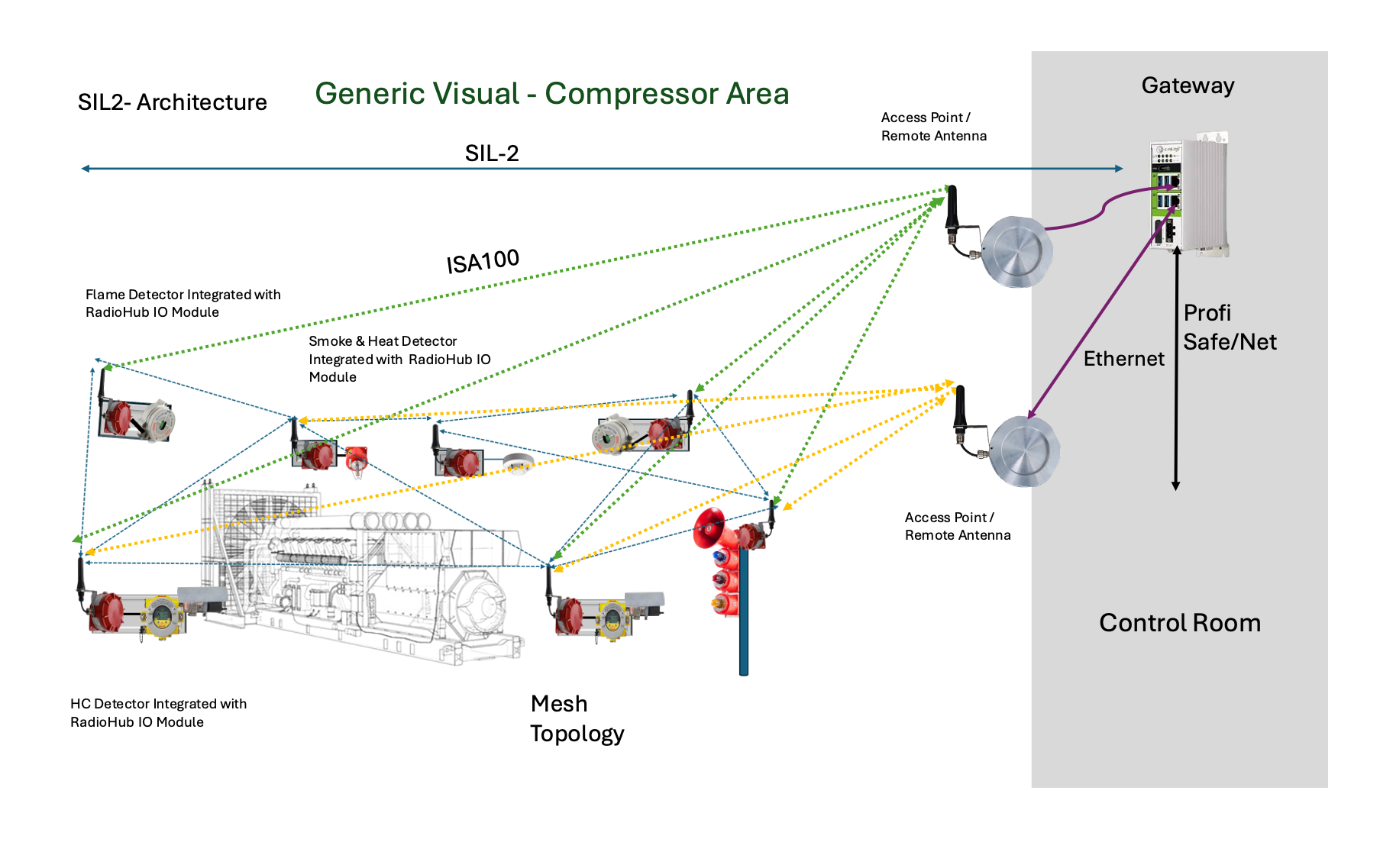
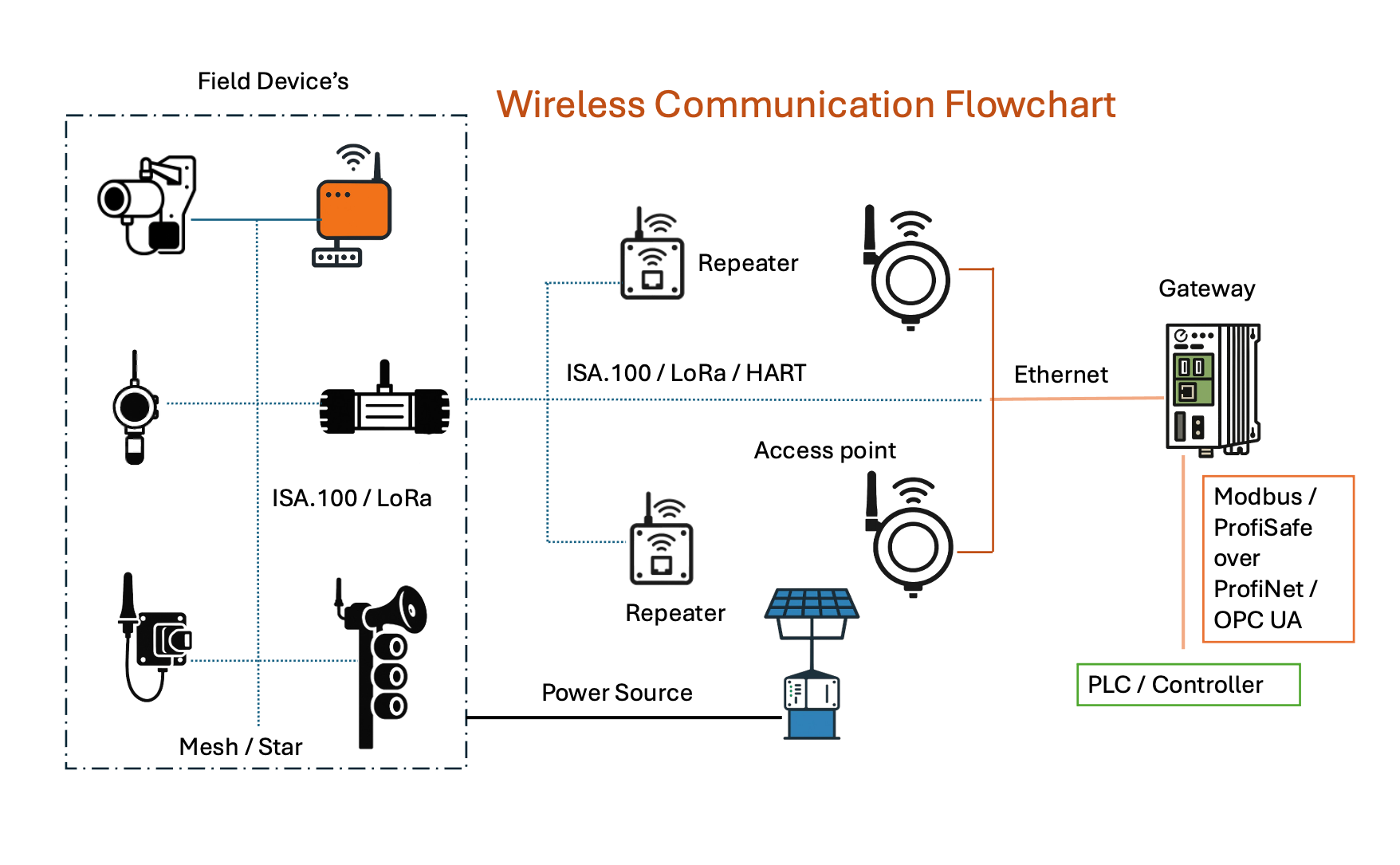
[Gas / Flame / Heat Detectors] → [RadioHub IO (ISA100)] → [Wireless Repeater] → [ISA100 Gateway] → [DCS/PLC]
↓
[Wireless Beacon/Sounder]
5. How the System Works – End-to-End Flow
Detection:
Fixed flammable gas detectors continuously monitor for leakages. On detection, an alert is triggered.
Signal Conversion & Transmission:
RadioHub IO modules convert and transmit data wirelessly using ISA100.11a protocol.
Routing:
Signals are routed through mesh repeaters to ensure stable coverage.
Control Room Communication:
Gateway translates ISA100 data into Modbus TCP/Profinet for DCS integration.
Alert Activation:
Zone 1 beacons/sounders are wirelessly triggered to alert field personnel.
Power Backup:
Solar panels + 24V Ex d batteries ensure 96+ hours of autonomy.
6. Device Deployment Plan
- 4x HC Gas Detectors
- 2x UV/IR Flame Detectors
- 2x Heat Detectors
- 1x Dräger ISA100 Wireless Repeater
- 1x Mimes WFNM ISA100 Gateway
- 2x Mimes RH-ALU Wireless Beacons/Sounders
- 8x Radio Hub IO
7. Key Technologies Used
| Component | Specification |
|---|---|
| Gas Detector | Dräger Polytron 8720 IR, Zone 1, SIL2 |
| Wireless IO | RadioHub IO (ISA100.11a, Modbus) |
| Repeater | Dräger Wireless Repeater with Mesh Capability |
| Gateway | Mimes WFNM ISA100 Gateway with Modbus/Profinet |
| Beacon/Sounder | RH-ALU Wireless Beacon (Zone 1, 110 dB) |
| Power Supply | 200–240W Solar + 24V Ex d Battery Pack |
8. Power and Autonomy
- Grouped device clusters powered by shared 240W solar panels
- 24V, 40Ah certified battery packs provide 96-hour backup
- Explosion-proof enclosures for solar charge controller and batteries
9. Benefits and Delivered Solutions
- No trenching or cable routing
- Deployment completed within 4 days per zone
- Real-time safety alerts both locally and remotely
- Fully compliant with IECEx, ATEX, SIL2, ISA100
- Future-ready design with mesh expansion
- Eliminates AC power dependence with solar autonomy
10. Cost Efficiency & Value
- Estimated 40–60% savings in installation and commissioning
- Minimal maintenance compared to wired systems
- Long-term ROI via avoided cabling costs and faster deployment
11. Future Scalability & Upgrades
- Add predictive sensors (vibration, temperature) to RadioHub
- Expand detection to nearby pump or skid zones
- Interface with SCADA or ESD systems via protocol mapping
12. Conclusion
This wireless fire and gas detection solution addresses compressor zone safety challenges with innovation, compliance, and efficiency. The system eliminates traditional wiring, ensures continuous protection through solar-powered autonomy, and offers flexible expansion for future needs. It represents a next-generation model for intelligent F&G systems in hazardous environments.