
Wireless-Enabled Upgrade for Deluge Suppression Systems
Wireless-Enabled Upgrade for Onshore Deluge Suppression Systems
Project Scope: Modernize existing deluge systems in onshore hazardous zones by replacing wired actuation and monitoring with wireless control infrastructure. Utilize existing field power supply (24V/230V) to support Radio Hub IO modules, wireless relays, and ISA100/LORA communication architecture.
Index:
- Executive Summary
- Current Challenges in Deluge System Architecture
- Upgrade Objectives
- System Working Concept
- Architecture Overview (Logical Flow)
- Components and Specifications
- Compliance Summary
- Deployment Strategy
- Cybersecurity & Reliability
- Benefits & ROI
- Advanced Diagnostics & Safety Logic
- Future Scalability
- Conclusion
1. Executive Summary
Deluge systems are critical components in fire suppression, especially in hazardous oil & gas environments. Traditional wired systems often face delays, degradation, and limited diagnostics. This report proposes a wireless upgrade leveraging the existing power infrastructure to transform deluge systems into intelligent, real-time, and highly reliable safety mechanisms. Using ISA100 wireless protocol and ATEX-rated hardware, the solution ensures rapid actuation, feedback monitoring, and seamless SCADA integration.
2. Current Challenges in Deluge System Architecture
- Aging or corroded signal cables causing faults or false triggering
- High cost and time associated with trenching and rewiring
- Limited diagnostics from remote field equipment
- Difficulty integrating new flame/gas detectors without disrupting existing systems
- Safety concerns due to slow or failed valve activation in emergencies
3. Upgrade Objectives
- Enable real-time wireless control and feedback of deluge valve systems
- Eliminate dependency on long-distance hardwiring
- Maintain Zone 1/2 compliance with explosion-proof certified devices
- Support modular expansion for additional sensors (gas, flame, pressure)
- Provide diagnostics and health status to control room
- Enable both field-side and control room-based manual deluge activation
4. System Working Concept
Detection Phase:
Flame or gas detectors continuously monitor the environment. Upon detecting fire or combustible gases, they transmit a signal to the local Radio Hub IO module.
Signal Conversion and Wireless Transmission:
Radio Hub IO converts the analog 4-20mA or digital signal into wireless packets using ISA100 protocol. These packets are sent through the wireless network to the central gateway.
Actuation Phase:
Automatic: The gateway processes the incoming alert and relays a wireless command to the field-mounted wireless relay module. The relay triggers the solenoid valve, initiating the deluge process.
Manual: A control room push-button triggers wireless relay activation via the gateway.
Field Override: Manual push button on field skid directly activates the local wireless relay (fail-safe, overrides auto logic).
Monitoring and Feedback:
Valve open/close status is monitored via DI signal and transmitted to SCADA.
Upstream and downstream pressure transmitters detect water flow pressure before and after valve actuation.
All signals are relayed wirelessly to control room.
Alarm Activation:
Simultaneously, a wireless signal activates Zone 1-rated sounders and beacons to warn nearby personnel.
Integration:
The ISA100 gateway transmits data to the DCS/SCADA system via Modbus TCP or Profinet.
5. Architecture Overview (Logical Flow)
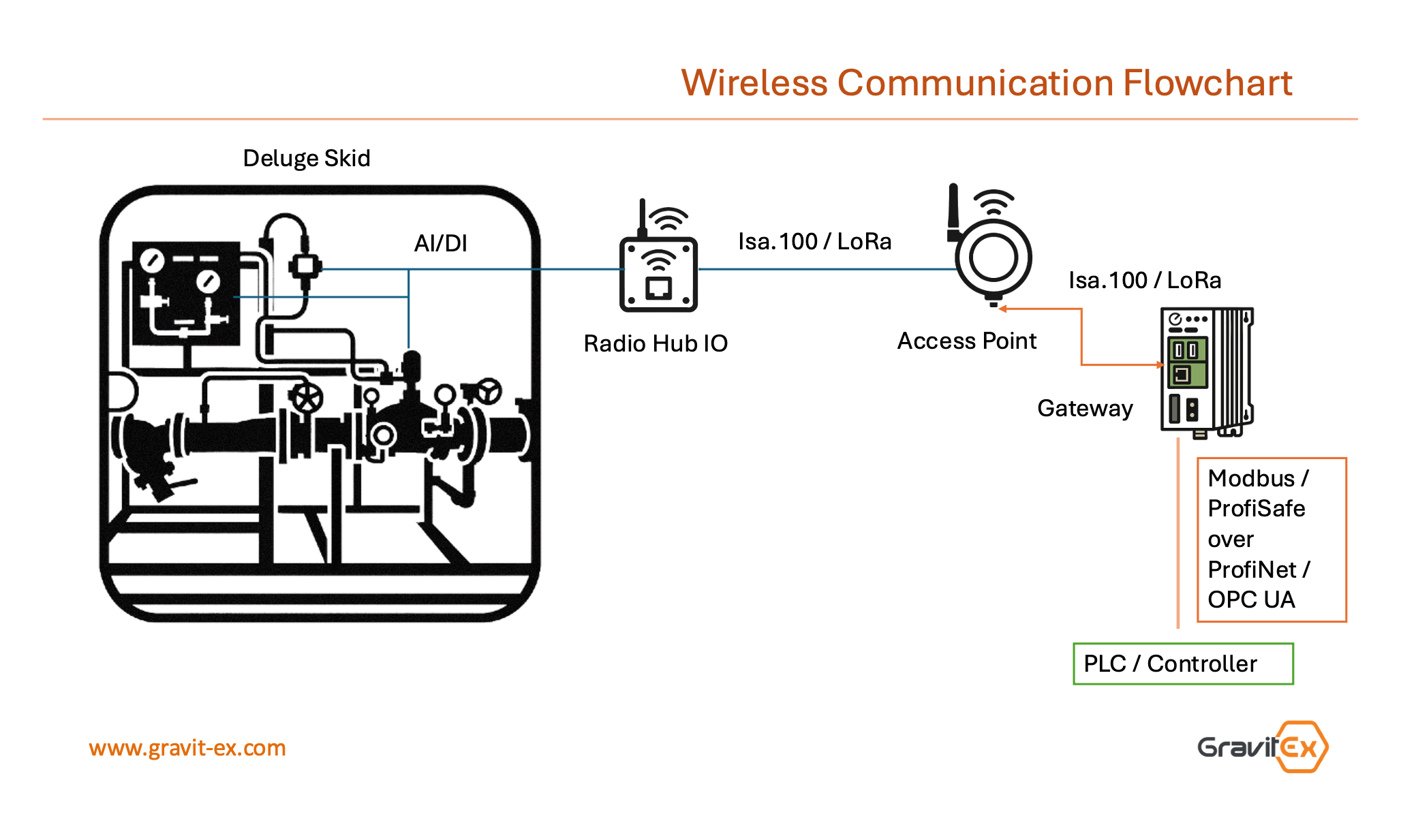
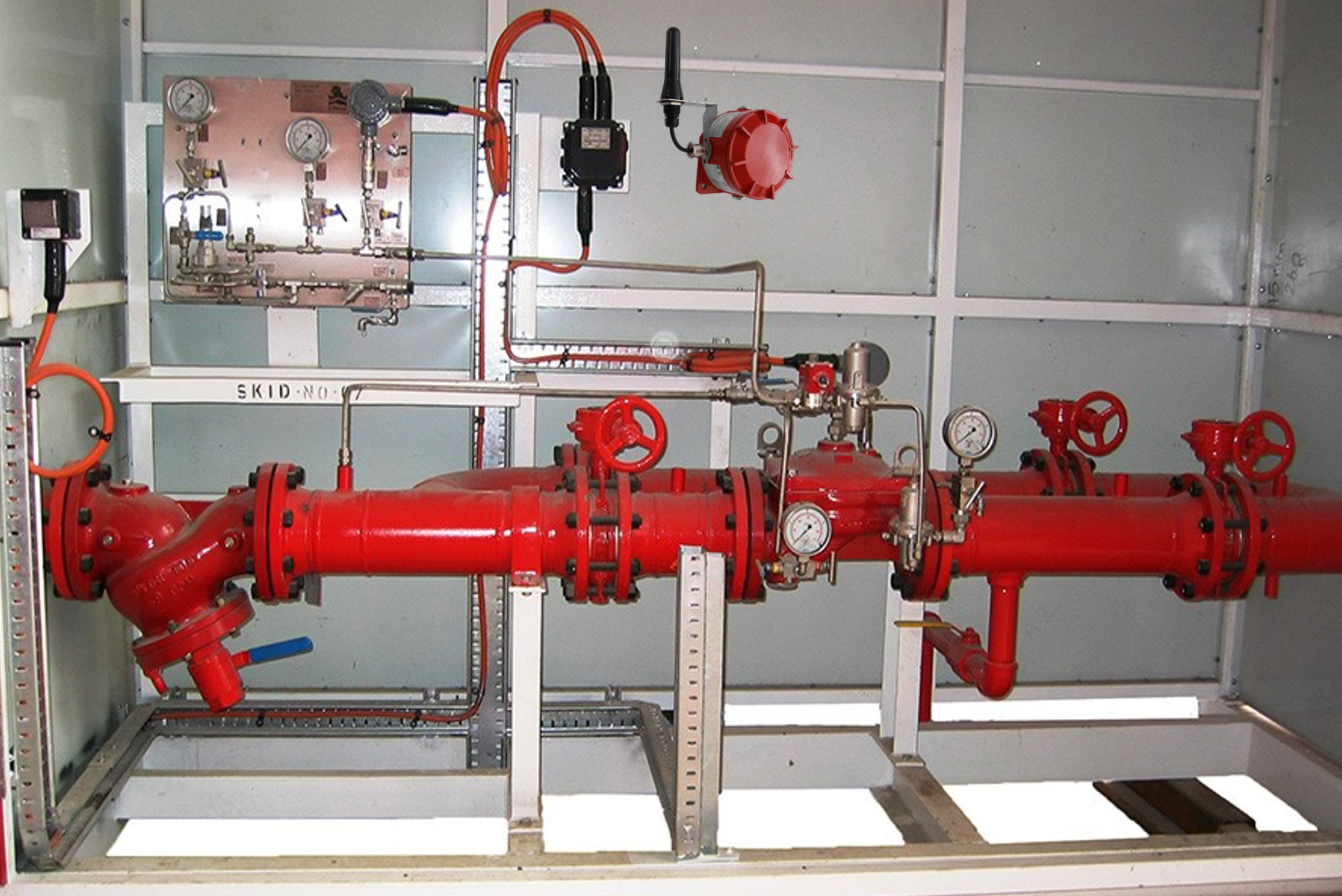
[Flame/Gas Detector] → [RadioHub IO AI]
[Upstream Pressure Transmitter] → [RadioHub IO AI]
[Downstream Pressure Transmitter] → [RadioHub IO AI]
[Manual Push Button - Field] → [RadioHub IO DI]
[Manual Push Button - Control Room] → [SCADA → Gateway]
[Gateway] → [Wireless Relay Output] → [Solenoid Valve]
[DI Feedback from Valve] → [RadioHub IO DI] → [ISA100 Gateway]
[ISA100 Gateway] → [DCS / SCADA]
[Alarm Output] → [Wireless Beacon / Sounder]
6. Components and Specifications
| Component | Description | Certs & Ratings |
|---|---|---|
| Flame Detector | UV/IR, Zone 1 | ATEX / IECEx, 4-20mA |
| Gas Detector | Catalytic / IR | ATEX / IECEx, ISA100/HART |
| Wireless Relay | Deluge Valve Actuation | Ex d, ISA100 |
| IO Module | RadioHub IO AI/DI | Ex d, 4-20mA / Dry Contact |
| Pressure Transmitter | Upstream/Downstream Monitoring | Ex d, 4-20mA |
| Manual Push Button | Field & Control Room Options | IP66, Dry Contact |
| Gateway | ISA100 Wireless Gateway | Modbus TCP/Profinet |
| Alarm | Wireless LED Beacon + Sounder | Zone 1, 110 dB |
7. Compliance Summary
- ATEX / IECEx: All field devices certified for Zone 1
- NFPA 15 / 72: System aligns with fire suppression and alarm standards
- ISA100.11a: Secure industrial wireless communication protocol
- SIL2: Loop and device reliability ensured with SIL2-rated devices
8. Deployment Strategy
- Use existing power lines to energize Ex d enclosures
- Mount RadioHub IO near each deluge skid
- Pair each valve with a dedicated wireless relay module
- Commission gateway and map all wireless endpoints
- Install upstream and downstream pressure transmitters and integrate with IO modules
- Set up both field and control room push buttons
- Test full activation logic: auto + manual + override scenarios
9. Cybersecurity & Reliability
- ISA100 AES-128 encryption
- Device whitelisting and channel hopping
- Watchdog timers on IO modules
- Manual override logic and emergency failsafe
10. Benefits & ROI
- 60% installation cost reduction (no trenching)
- Faster commissioning during live plant operations
- Real-time response (<2s)
- Lower maintenance (no cable wear)
- Full diagnostics and visibility at control room
- Dual activation paths: SCADA and field-level
11. Advanced Diagnostics & Safety Logic
- Valve Stroke Time Monitoring
- Pressure Drop Analysis
- Sensor Self-Test Alerts
- Heartbeat Signals from field devices
- Gateway failsafe logic with alert retries
- QR Code access to device health
12. Future Scalability
- Add condition-based monitoring (temperature, humidity)
- Integrate with foam or water mist system
- Enable cloud dashboard & mobile app alerts
13. Conclusion
By combining wireless ISA100 communication, existing power infrastructure, and advanced diagnostics, this deluge system upgrade ensures safer, faster, and intelligent suppression control. The dual activation options from control room and field, pressure feedback, and seamless SCADA integration make this an ideal safety retrofit for onshore critical zones.