
Wireless H₂ Detection System – Confidential Deployment
Wireless H₂ Detection System for Fertilizer Facility Safety
Confidential Client: Fertilizer Facility Operator
Application Type: Zone 1 Hazardous Area – Wireless Real-Time Hydrogen Monitoring
1. Project Scenario Overview
A fertilizer facility required an advanced hydrogen (H₂) detection system to enhance safety in a high-risk process area with potential H₂ leaks from a reactor. Nitrogen injection was planned to dilute H₂ concentrations, necessitating real-time monitoring to ensure safety and compliance in a Zone 1 hazardous environment.
2. Application Objectives
- Deploy two H₂ gas sensors at 30m elevation
- Install ground-level transmitter for inspection
- Ensure reliable communication over 100m to control room
- Provide battery operation with 72-hour autonomy
- Enable wireless integration with existing DCS/PLC
- Include optional solar panel for charging
- Support scalability for future sensor additions
3. Technical Challenges Identified
- Hazardous Environment (Zone 1): All components must be certified for explosive atmospheres
- Elevated Sensor Placement: Sensors at 30m height require robust mounting and signal transmission
- Long-Distance Communication: Stable wireless signals over 100m to the control room
- Power Autonomy: No reliance on existing power infrastructure
- Environmental Durability: Resistance to industrial conditions (e.g., chemical exposure, temperature fluctuations)
4. System Architecture Overview (Wireless + Solar)
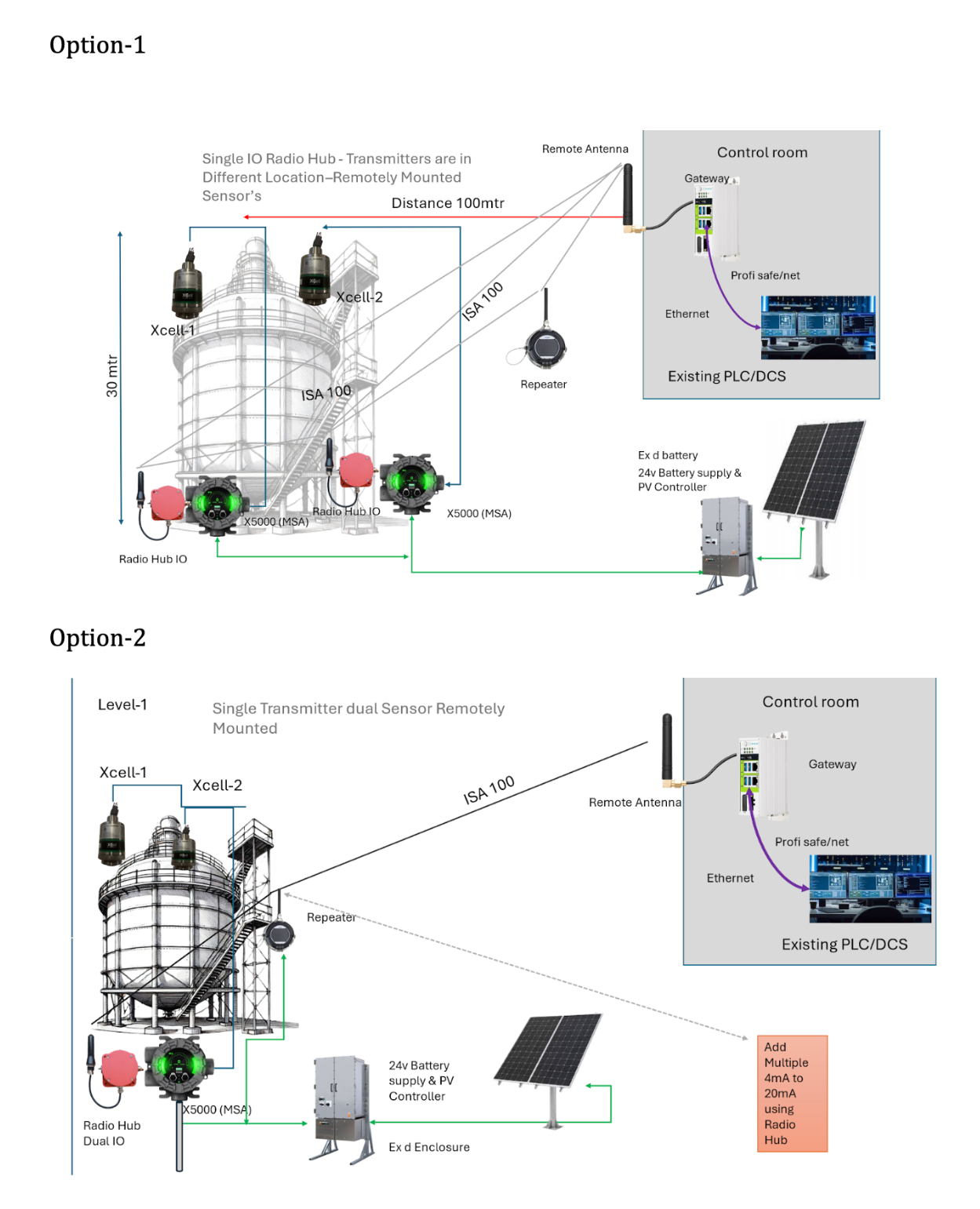
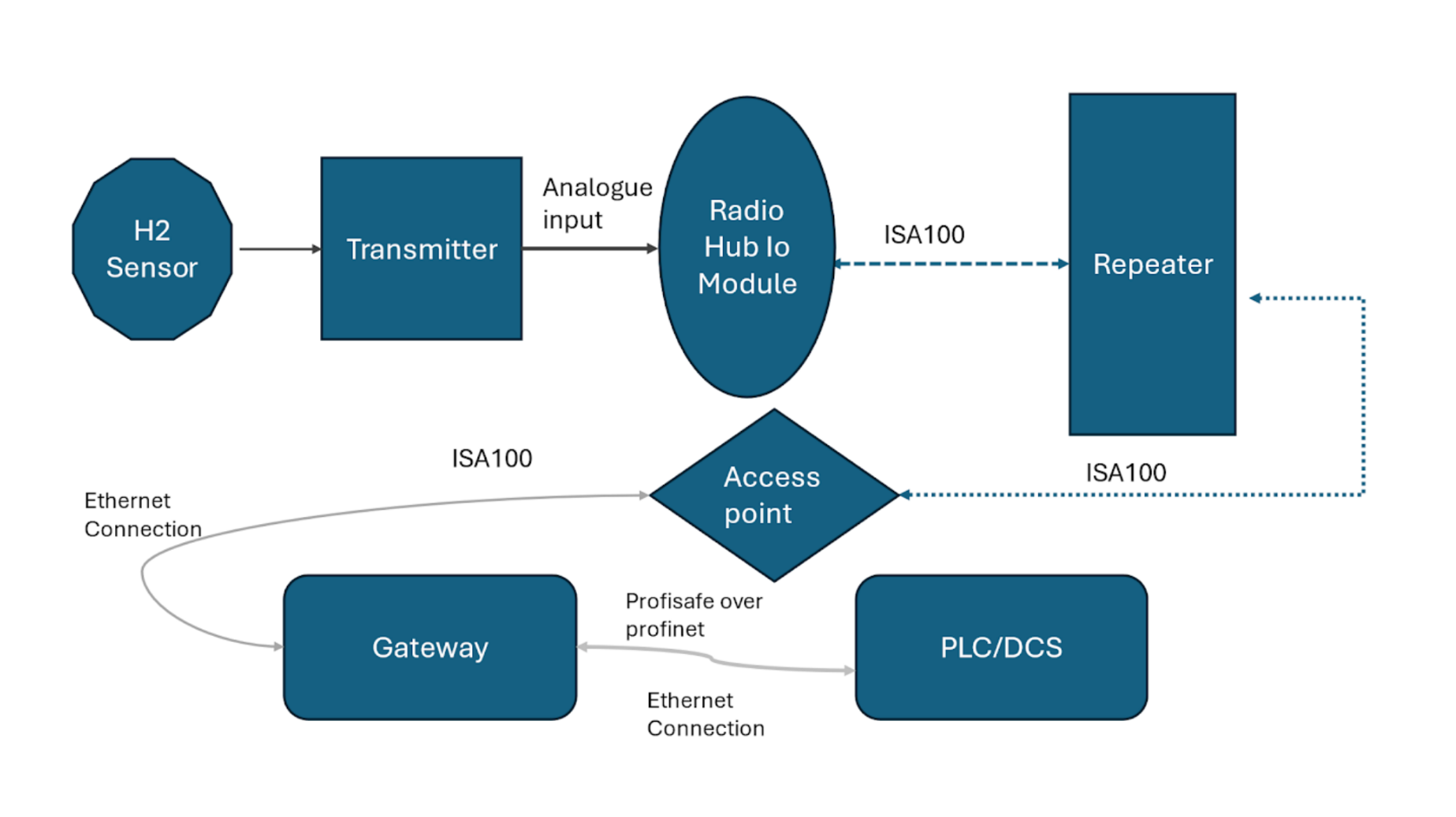
[X5000 MSA Gas Detector (Dual Sensor)] → [RadioHub IO (ISA100)] → [Dräger Repeater] → [ISA100 Gateway] → [PLC/DCS]
[Ex d Battery System + 240W Solar Panel]
5. How the System Works – End-to-End Communication Flow
Hydrogen Detection (Event Trigger):
X5000 MSA Gas Detectors (dual sensors) at 30m elevation continuously monitor H₂ levels. When concentrations exceed thresholds, an alarm signal is generated.
Signal Transmission:
The alarm is relayed to a ground-level RadioHub IO Module, which converts the data into an ISA100.11a wireless signal.
Repeater Handoff and Signal Routing:
A Dräger repeater extends the signal, ensuring reliable transmission over 100m to the gateway.
Gateway Communication:
The ISA100 Gateway converts the signal to ProfiSafe over Profinet for secure integration with the PLC/DCS.
Control Room Integration:
The gateway forwards the signal to the control room for real-time monitoring and logging.
Power Autonomy:
Each node is powered by an Ex d battery system with 72-hour autonomy, supplemented by a 240W solar panel with a PV controller.
6. Key Technologies Used
| Component | Details |
|---|---|
| Gas Detector | X5000 MSA Dual Sensor, Zone 1 compliant, wireless-capable |
| Transmitter | RadioHub IO Module, ISA100.11a protocol |
| Repeater | Dräger wireless repeater with mesh routing |
| Gateway | ISA100, ProfiSafe over Profinet |
| Power System | 240W solar panel + Ex d battery with 72-hour autonomy |
7. Benefits & Solutions Delivered
- Reduced Infrastructure: Wireless design eliminates long cable runs
- Zone 1 Compliance: All components certified for hazardous areas
- Autonomous Operation: Solar and battery power for 72-hour autonomy
- Real-Time Monitoring: Seamless DCS/PLC integration for instant alerts
- Compact Design: Dual-sensor system reduces footprint
- Scalability: Supports future addition of sensors or devices
8. Cost Efficiency
While specific pricing is not disclosed, the system offers significant cost savings by eliminating cabling and trenching, reducing installation time and labor costs by an estimated 30–50% compared to traditional wired systems.
9. Future Scalability
- Plug-and-play addition of sensors or alarms
- Mesh network expansion via additional repeaters
- Solar and battery systems support increased device loads
10. Conclusion
The wireless H₂ detection system provides a robust, scalable, and infrastructure-free solution for hazardous area monitoring in fertilizer facilities. Leveraging ISA100 wireless technology, Zone 1-compliant devices, and solar-powered autonomy, it ensures real-time safety monitoring with minimal maintenance and future-ready scalability. This system sets a standard for efficient, cost-effective safety solutions in high-risk industrial environments.