

Offshore Corrosion Monitoring Trial - Wireless Upgrade with Gravitex Integration
Offshore Corrosion Monitoring Trial – Wireless Upgrade with GravitEx Integration
Project Type: Offshore Pipeline Monitoring | Zone 1 Trial Deployment
Focus: Wireless Integration for Non-Intrusive Corrosion Monitoring
Executive Summary
This case scenario outlines a wireless corrosion monitoring trial conducted on an offshore platform to validate the integration of non-intrusive ultrasonic sensors with GravitEx’s ISA100 wireless communication system. The goal was to replace manual inspection routines and isolated data loggers with a real-time, SCADA-connected, wireless corrosion monitoring system in a Zone 1 classified environment. This project demonstrates how existing corrosion sensor systems can be upgraded for continuous monitoring and seamless integration into platform control systems using GravitEx wireless architecture.
1. Project Background
Offshore pipelines and risers are highly susceptible to corrosion, particularly at splash zones, bends, weld seams, and pipe support areas. The operator sought to trial an upgrade for their current corrosion monitoring practice, which relied on periodic ultrasonic measurements using handheld tools or standalone loggers. The objective was to enable live wall-thickness monitoring, eliminate manual data retrieval, and evaluate a wireless upgrade path using Radio Hub IO ISA100-enabled infrastructure.
2. Monitoring Objectives
- Enable continuous monitoring of pipe wall thickness in corrosion-prone offshore zones
- Integrate existing ultrasonic sensor arrays with a Zone 1-certified wireless IO system
- Transmit sensor data in real-time to the platform control room
- Avoid trenching, cable routing, or battery dependence by using line power
- Validate system stability, data integrity, and offshore ruggedness under real conditions
3. Trial Area & Conditions
- Location Type: Offshore Production Platform – Topside Area
- Structure Monitored: 12" pipeline riser (critical section near splash zone and pipe support)
- Environmental Zone: Zone 1 – High humidity, salt fog, vibration
- Power Availability: 24VDC from instrument junction box
- Existing Sensor System: Non-intrusive clamp-on UT thickness sensors (pre-installed)
4. Challenges Faced in the Legacy System
- Manual data collection routines: Required technician access to hazardous areas
- No real-time visibility: Corrosion progression remained undetected between visits
- Battery-powered data loggers: Limited runtime; frequent servicing needed
- Cable routing limitations: Infeasible to trench or route cables in offshore layouts
- Environmental interference: Inconsistent readings and EMI in traditional setups
- SCADA disconnect: No live monitoring or trending in control room
5. Wireless Integration with GravitEx
GravitEx provided a modular ISA100 wireless IO system with the following features:
- Zone 1-certified RadioHub IO mounted near the sensor cluster
- Captured 4–20 mA and digital output signals from ultrasonic wall thickness sensors
- Connected to platform’s 24VDC line power — no solar or battery used
- Wireless communication via ISA100.11a with optional repeater nodes
- Gateway placed in control zone, interfacing with SCADA via Modbus TCP/IP
6. Architecture Overview
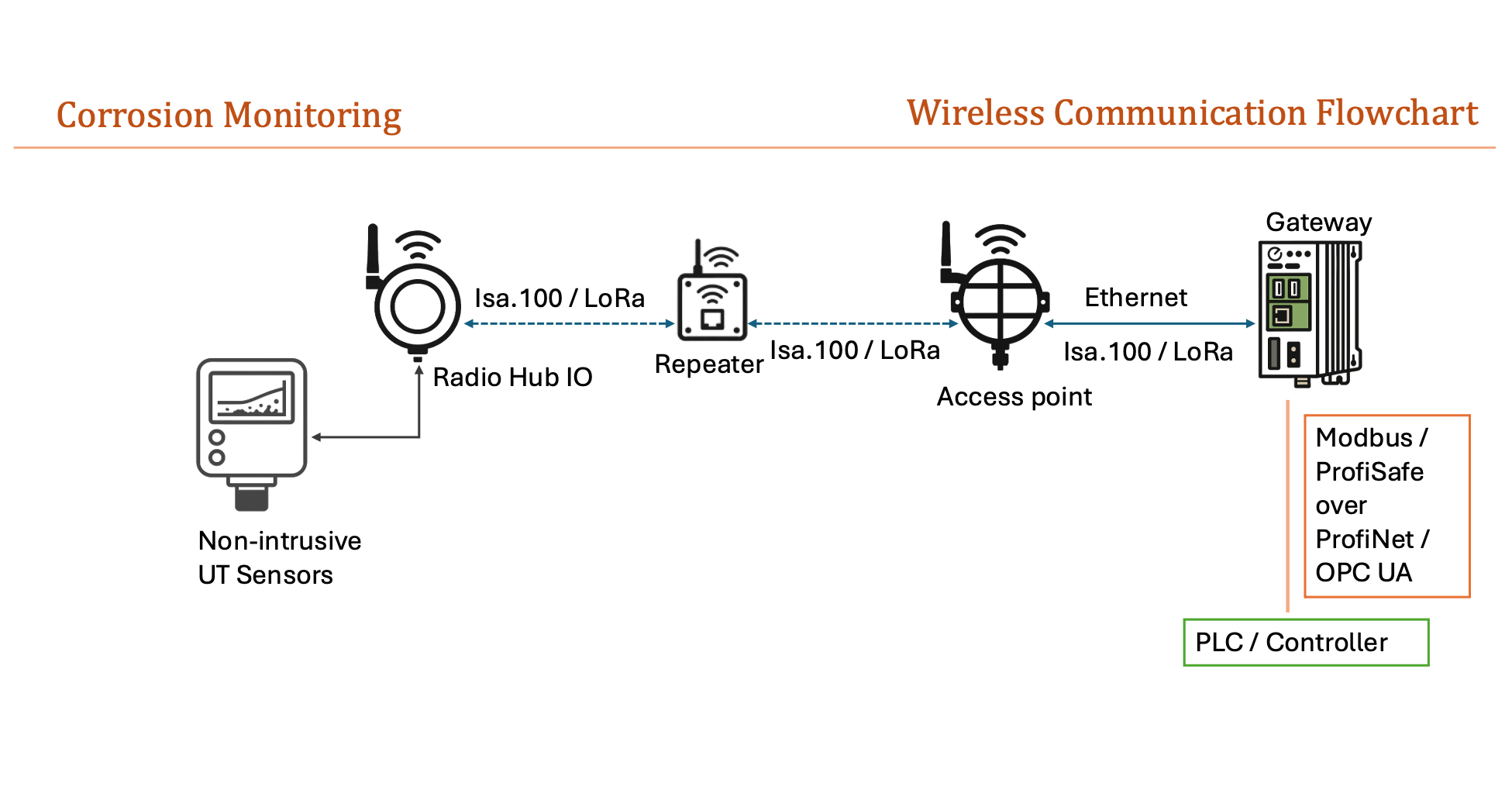
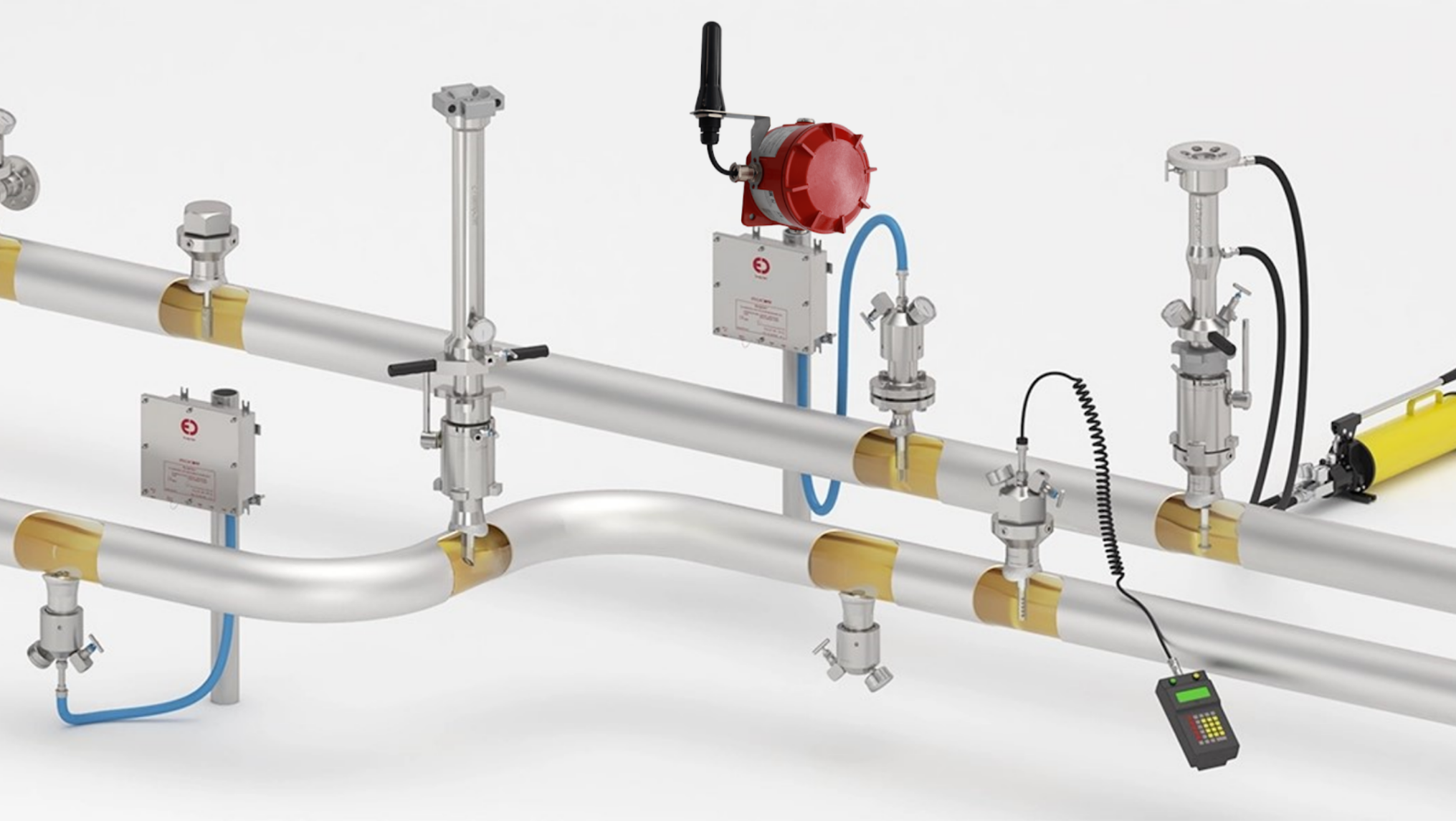
[Non-intrusive UT Sensors] → [RadioHub IO – ISA100] → [Repeater Node (if needed)] → [ISA100 Gateway] → [Platform SCADA / Dashboard]
↓
[24VDC Power Supply – Zone 1]
7. Trial Execution and Workflow
- Verified existing sensor system for ISA100 IO compatibility
- Mounted RadioHub IO in Ex d enclosure, interfaced with ultrasonic probes
- Installed repeater node for optimal wireless communication
- Gateway installed in control cabin, connected to SCADA
- Conducted trial over 30 days with hourly data polling and logging
8. Technical Highlights
- Wireless Range: Stable at ~300 m with repeater
- Power Source: 24VDC
- Update Interval: 10-minute configurable
- Zone Compliance: ATEX / IECEx Zone 1 certified
- Protocol: ISA100.11a with AES-128 encryption
- Integration: Modbus TCP/IP to SCADA
9. Benefits Observed
- Real-time corrosion data with automatic logging
- No manual retrieval or safety permits required
- Reliable wireless performance in offshore conditions
- Seamless SCADA integration
- Reduced HSE exposure
- Foundation for predictive maintenance workflows
10. Post-Trial Recommendation
- Extend monitoring to additional risers and lines
- Add wireless leak and vibration sensors
- Integrate with cloud-based pipeline integrity dashboards
11. Conclusion
This offshore trial validated GravitEx’s capability to wirelessly integrate third-party corrosion sensors in Zone 1. It enabled reliable, real-time corrosion monitoring while eliminating the need for manual inspections or complex cabling. The wireless upgrade offers a scalable and compliant solution for future-ready offshore pipeline integrity monitoring.