

Wireless Fire & Gas Detection System for Offshore Platform
Wireless Fire & Gas Detection System for Offshore Platform
Confidential Client: Offshore Oil & Gas Operator – Middle East
Application Type: Zone 1 Offshore – Autonomous Wireless Safety System
Executive Summary
This project delivers a wireless, solar-powered Fire & Gas (F&G) detection system tailored for a remote offshore platform. By using ISA100.11a wireless communication and ATEX-certified components, the system provides continuous real-time monitoring, local alarm signaling, and complete autonomy from grid power. The architecture supports modular scalability and significant cost savings over traditional wired systems. This document outlines the technical design, deployment strategy, and safety compliance.
Contents:
- Project Scenario Overview
- Application Objectives
- Technical Challenges
- Regulatory Standards and Design Basis
- System Architecture Overview
- How the System Works – End-to-End Flow
- Device Deployment Plan
- Key Technologies Used
- Power and Autonomy
- Benefits and Delivered Solutions
- Cost Efficiency & Value
- Future Scalability & Upgrades
- Compliance Summary
- Risk Assessment Matrix
- Deployment Timeline
- Conclusion
1. Project Scenario Overview
Offshore platforms are high-risk, space-constrained environments exposed to saltwater, vibration, and explosive gases. This project deploys a wireless Fire & Gas (F&G) detection system on a remote offshore wellhead platform to enable 24/7 monitoring without trenching or complex wiring. The system uses ISA100.11a wireless protocol with solar-powered autonomy, fully compliant for Zone 1 explosive environments.
2. Application Objectives
- Detect hydrocarbon gas leaks in hazardous deck zones
- Monitor open flames or flash fires
- Detect abnormal temperature rise on equipment housings
- Transmit wireless alarms to offshore RTU or control unit
- Trigger field alerts via visual and audible wireless devices
- Operate independently without AC power
- Meet ATEX/IECEx Zone 1 requirements
3. Technical Challenges
- Harsh conditions: corrosion, salt fog, vibration, humidity
- Absence of power and communication infrastructure
- Limited space for mounting and wiring
- Real-time alerting needed for remote operations
- All components must meet Zone 1, SIL2 standards
4. Regulatory Standards and Design Basis
- IEC 60079-10-1 (Area Classification)
- NFPA 72 (Fire Detection Code)
- API RP 14FZ (Offshore Electrical Systems)
- ISA100.11a (Wireless Industrial Networks)
- IEC 61508 / SIL2 (Functional Safety)
5. System Architecture Overview
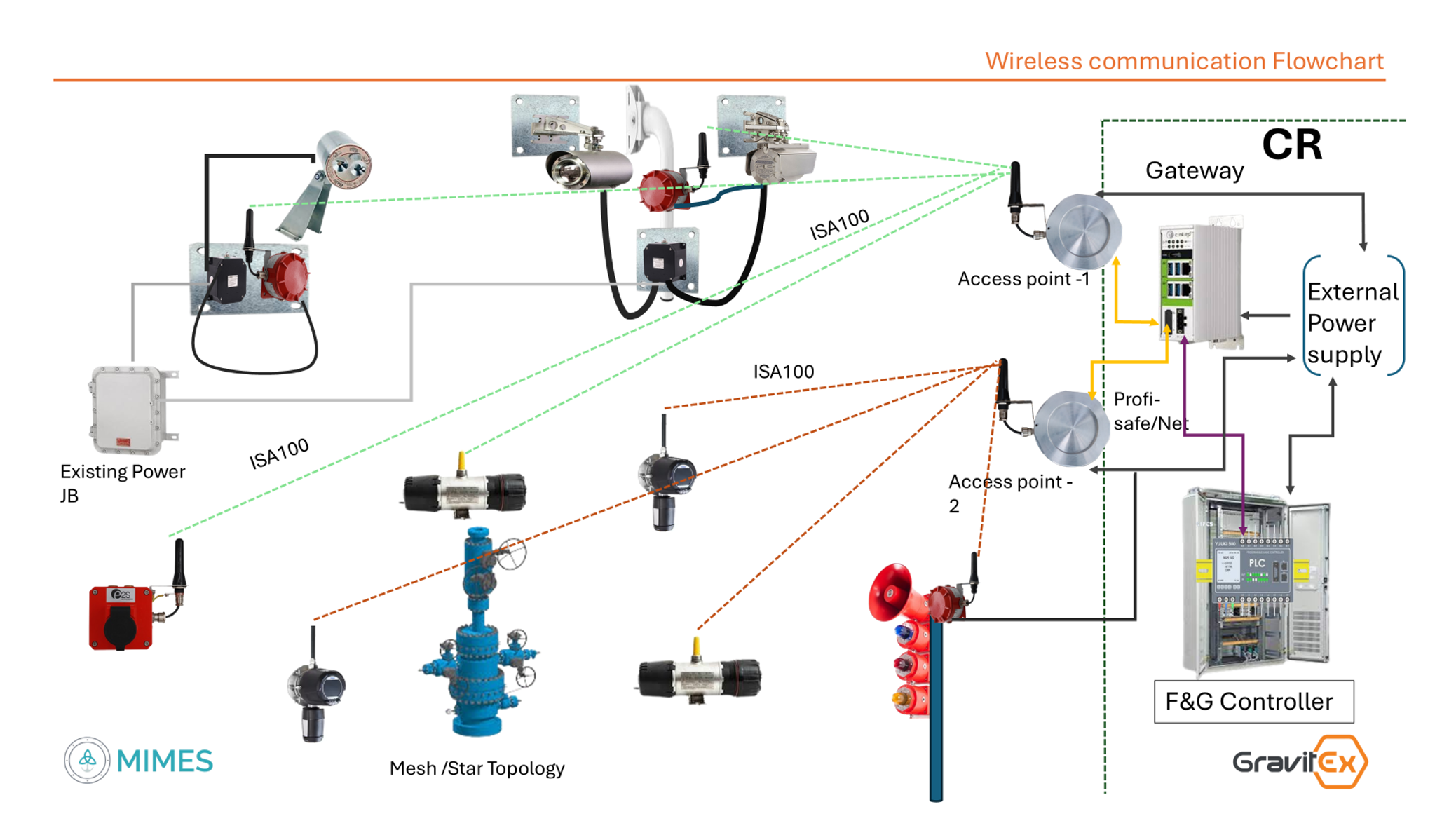
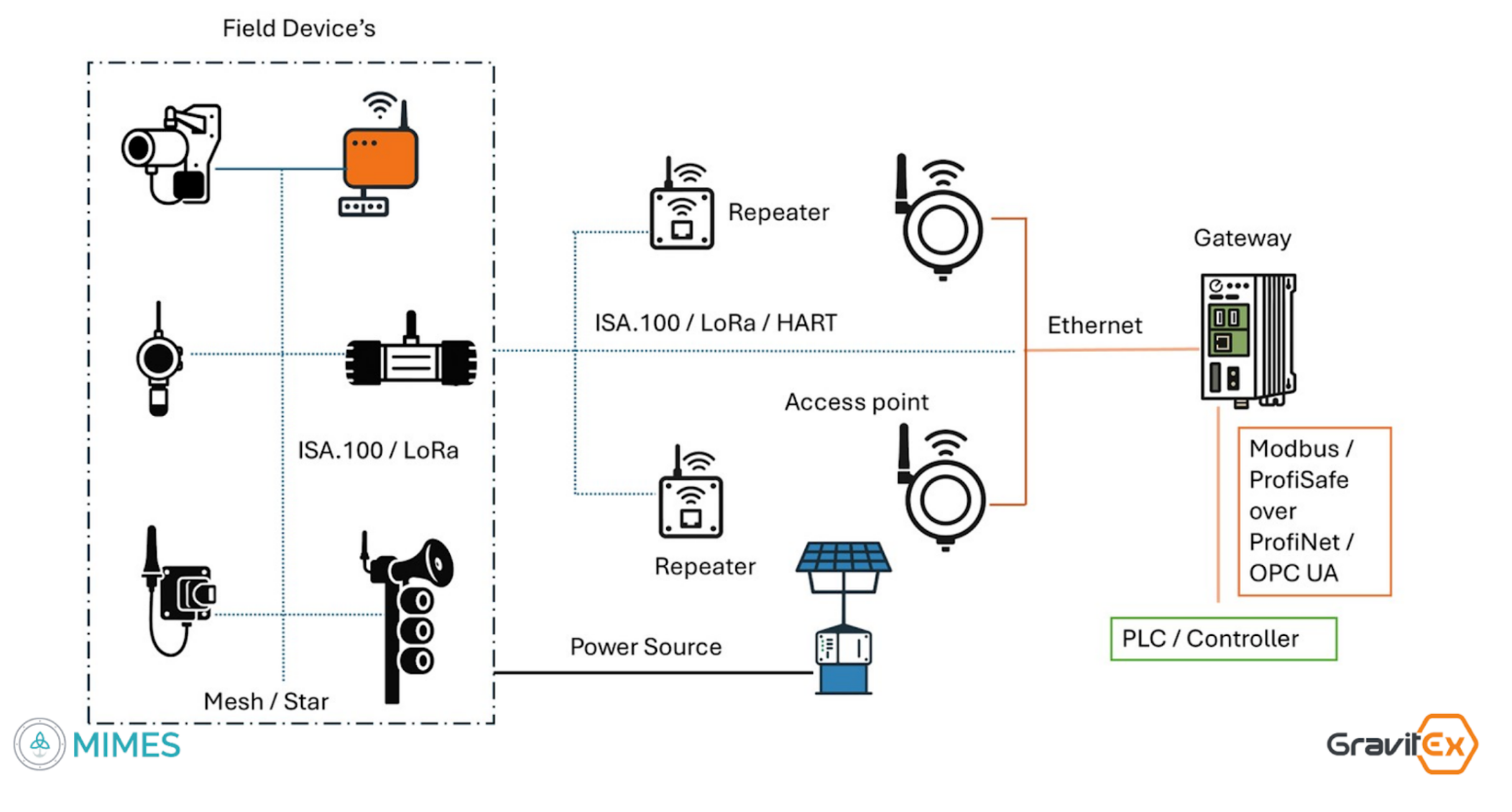
[Flame / Gas / Heat Detectors] → [RadioHub IO (ISA100)] → [ISA100 Wireless Repeater] → [ISA100 Gateway in Safe Zone] → [RTU/DCS]
↓
[Wireless Beacon/Sounder on Process Deck]
6. How the System Works – End-to-End Flow
Detection:
Gas and flame detectors monitor deck and helideck zones. Upon detection, an alarm is triggered.
Transmission:
Radio Hub IO converts sensor output to ISA100 wireless protocol.
Routing:
Signals pass through mesh-enabled repeaters installed at elevated offshore locations.
Control Room Communication:
ISA100 gateway forwards signal to RTU/DCS via Modbus TCP or Profinet.
Alert Activation:
Wireless beacons and sounders are activated for local field notification.
Power Backup:
Solar panel and Ex d battery system ensures 96-hour operational backup.
7. Device Deployment Plan
- 6x HC Gas Detectors (Zone 1)
- 2x UV/IR Flame Detectors
- 2x Heat Detectors (Motor & turbine area)
- 2x ISA100 Wireless Repeaters
- 1x Mimes WFNM ISA100 Gateway (safe zone)
- 3x RH-ALU Wireless Beacons/Sounders
- 10x RadioHub IO Modules
8. Key Technologies Used
| Component | Specification |
|---|---|
| Gas Detector | Dräger Polytron 8720 IR, Zone 1, SIL2 |
| Flame Detector | MSA FL500 UV/IR, Zone 1 |
| Heat Detector | Thermistor/Rate-of-Rise, Marine-grade |
| Wireless IO | RadioHub IO with ISA100.11a |
| Repeater | Offshore-rated ISA100 Mesh Repeater |
| Gateway | Mimes WFNM Gateway (Modbus TCP/Profinet) |
| Alarms | RH-ALU Beacon/Sounder (110 dB, Zone 1) |
| Power | 240W Solar + 24V Ex d Lithium Battery Pack |
9. Power and Autonomy
- Each 240W solar panel supports 2–3 devices
- 24V, 40Ah certified Ex d battery pack provides 96h autonomy
- Charge controllers housed in Zone 1/Zone 2 enclosures
- Diagnostics monitored wirelessly via Radio Hub IO
10. Benefits and Delivered Solutions
- 100% wireless and solar-powered solution
- No trenching, cable trays, or penetrations
- ATEX/IECEx Zone 1 and SIL2 certified architecture
- Rapid installation and commissioning
- Ideal for remote, unmanned platforms
11. Cost Efficiency & Value
- 40–60% cost savings vs. wired installations
- Reduced engineering, cable routing, and panel space
- ROI via accelerated deployment and low maintenance
12. Future Scalability & Upgrades
- Add vibration/condition sensors for predictive diagnostics
- Extend coverage to new decks, helideck, flare boom
- Integrate portable gas detectors and emergency systems
13. Compliance Summary
| Standard / Regulation | Compliance Status |
|---|---|
| IEC 60079-10-1 | Zone 1 Area Classification Verified |
| ISA100.11a | Used for all wireless communication |
| IEC 61508 / SIL2 | All detectors SIL2 rated |
| ATEX / IECEx | Certified devices for explosive atmospheres |
| NFPA 72 | Visual and audible alarms deployed |
| API RP 14FZ | Design compliant for offshore installations |
14. Risk Assessment Matrix
| Hazard Scenario | Risk Level | Mitigation Strategy |
|---|---|---|
| HC Gas Leak on Process Deck | High | HC Detectors + ISA100 Alerting + Beacons |
| Flash Fire at Turbine Area | Critical | UV/IR Flame Detectors + Control Shutdown |
| Power Loss (Storm Conditions) | Medium | Solar + 96h Battery Backup |
| Communication Failure | Low | Mesh Repeater Redundancy + Diagnostic Alerts |
15. Deployment Timeline
| Activity | Duration | Dependencies |
|---|---|---|
| Equipment Delivery | 2 Weeks | Certification Requirements |
| Offshore Installation | 3 Days | Shutdown Window Access |
| Functional Testing | 2 Days | Mesh Configuration |
| Commissioning & Acceptance | 1 Day | Client Witness |
16. Conclusion
This offshore wireless Fire & Gas detection system provides a rugged, autonomous, and compliant solution tailored for high-risk environments. It significantly reduces infrastructure requirements, accelerates deployment timelines, and supports scalable safety upgrades for offshore operations.