
Wireless Upgrade for Onshore Wellhead & Christmas Tree Systems
Wireless Upgrade for Onshore Wellhead & Christmas Tree Systems
Confidential Client: National Oil & Gas Operator – Middle East
Application Type: Zone 1/2 Hazardous Area – Wireless Modernization of Wellhead & X-Mas Tree Infrastructure
1. Project Scenario Overview
Many onshore wellhead and Christmas tree (X-Mas Tree) facilities rely on manual gauges and analog signal pathways, limiting automation, accuracy, and safety. This project proposes a wireless upgrade utilizing modular Radio Hub IO units and industrial gateways, providing seamless integration with existing DCS/SCADA systems via Modbus, Profinet, or OPC-UA for real-time monitoring and control.
2. Modernization Objectives
- Enable remote monitoring of wellhead pressure (WHP), tubing pressure (TP), annulus pressure (AP), temperature, and flow rate
- Wirelessly monitor actuator and valve positions in real-time
- Replace analog infrastructure with wireless IO modules
- Power the system using autonomous solar and battery packs
- Minimize field wiring, trenching, and operational shutdown
- Ensure Zone 1/2 compliance for all components
3. Challenges in Traditional Systems
- Manual Instrumentation: Increases error and delays in data collection
- Harsh Zone Classifications: Retrofitting challenges in Zone 1/2 environments
- Lack of Power Infrastructure: Remote areas lack grid power for sensor modules
- Signal Interference: Steel piping and terrain disrupt wireless signals
- Cybersecurity Risks: Lack of protocol security in traditional systems
- Operational Downtime: Retrofitting leads to production delays
4. Compliance & Design Standards
- IEC 60079-10-1 (Hazardous Area Classification)
- ATEX/IECEx Certified Devices (Zone 1/2)
- ISA100.11a, Wireless HART, and LoRa Protocols
- IEC 61508 (SIL2 Functional Safety Compliance)
- Modbus TCP/IP, MQTT, OPC-UA Communication Standards
5. System Architecture Overview
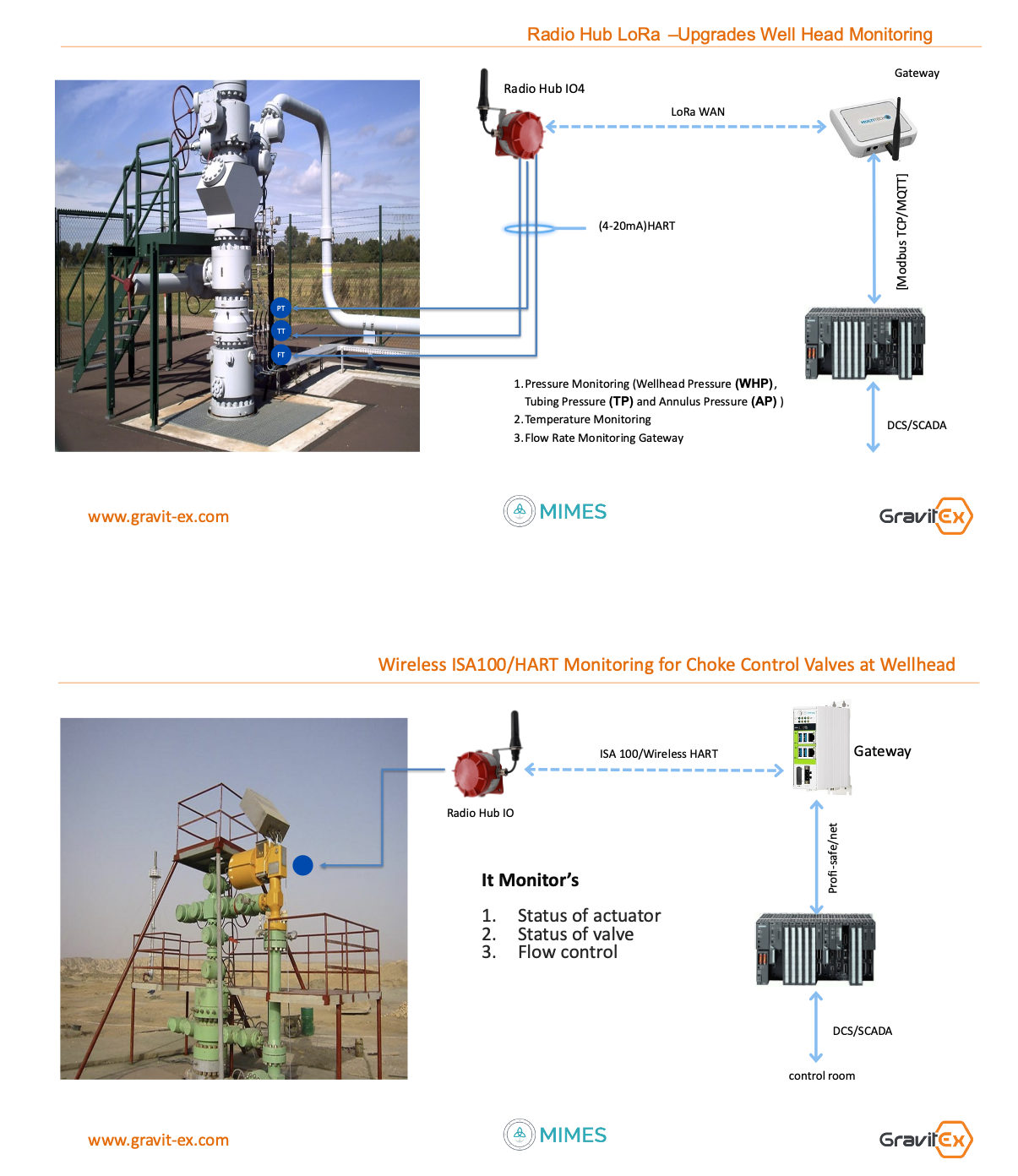
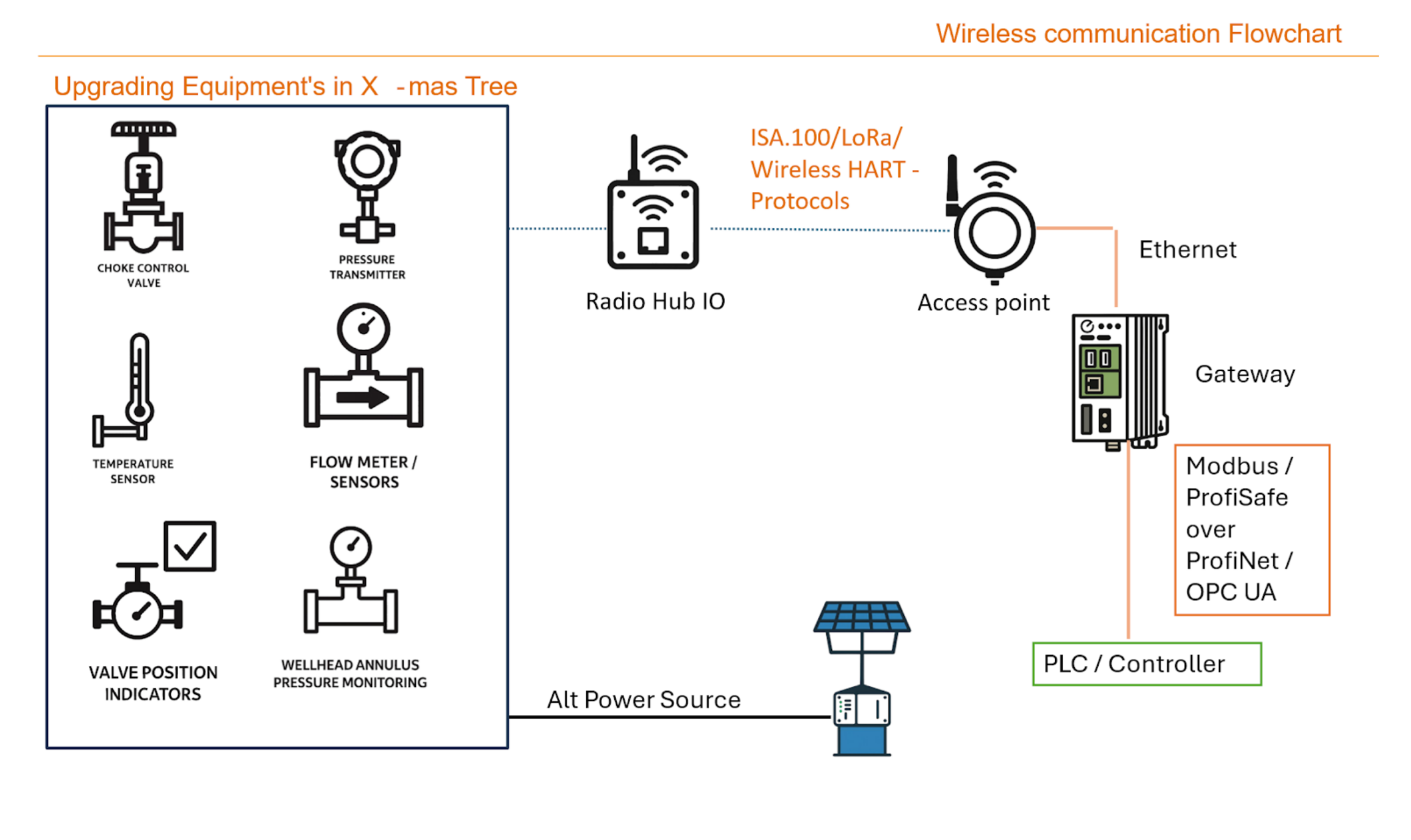
[Pressure/Temp/Flow Sensors] → [RadioHub IO (ISA100/LoRa)] → [Repeater Node (if needed)] → [Industrial Gateway] → [SCADA/DCS System]
[Field Alarm/Indicator (Optional)]
6. Wireless Communication Logic
Signal Conversion:
Radio Hub IO converts sensor analog/digital outputs to encrypted wireless signals using ISA100, Wireless HART, or LoRa protocols.
Signal Transmission:
Signals are transmitted to access points or gateways, with repeaters used if needed for extended range.
Data Integration:
Gateways push data to DCS/SCADA systems via Modbus TCP, MQTT, or OPC-UA.
Protocol Flexibility:
Radio Hub supports multiple protocols (LoRaWAN, ISA100, Wireless HART) for versatile deployment.
7. Components to be Upgraded
- Wellhead Pressure Monitoring (WHP)
- Tubing Pressure Monitoring (TP)
- Annulus Pressure Monitoring (AP)
- Choke Valve Control & Status
- Flow Rate & Temperature Monitoring
- Actuator Position Feedback
8. Device Mapping & Functions
| Function | Device/Component | Protocol |
|---|---|---|
| WHP, TP, AP Monitoring | Pressure Transmitters + Radio Hub IO | LoRa/ISA100 |
| Temperature/Flow Monitoring | Multivariable Transmitter | ISA100/Wireless HART |
| Valve/Actuator Status | Digital Inputs + Radio Hub IO | ISA100 |
| Wireless Relay for Alarms | IO + Beacon/Sounder (Optional) | ISA100 |
| Data Aggregation & Transfer | Gateway (Mimes WFNM or similar) | Modbus/MQTT |
9. Power & Autonomy Strategy
- 240W solar panel for 2–4 device clusters
- 24V Ex d lithium-ion battery with 96-hour autonomy
- Zone-rated Ex d/Ex e enclosures for energy modules
- Optional load monitoring and diagnostics via RadioHub
10. Deployment & Integration Flow
- Install wireless IO at field instrumentation points
- Connect sensors to IO (4-20 mA, HART, or digital)
- Mount solar panel and battery packs locally
- Set up mesh communication with repeater (if required)
- Install gateway near control hut or safe zone
- Connect DCS/SCADA via Ethernet or fiber
- Commission and test the system
11. Cybersecurity & Data Integrity
- ISA100 supports AES-128 encryption
- Channel hopping and frequency diversity for signal reliability
- Gateways secured with VPN/tunnel support
- Device authentication before pairing
12. Benefits & ROI Summary
- Cost Savings: Reduces 50–60% in cabling and labor costs
- Rapid Deployment: 3–5 days installation per well site
- Advanced Analytics: Enables predictive diagnostics and digital twin setups
- Infrastructure-Free: Field mobility with zero reliance on wired infrastructure
- Low Maintenance: Reduced cost of ownership with minimal service needs
13. Future Expansion & Scalability
- Add vibration, leak, or sand detection sensors
- Integrate wireless shutdown logic via relay modules
- Connect to centralized cloud dashboard via MQTT
14. Conclusion
This wireless upgrade transforms aging wellhead and X-Mas tree systems into intelligent, connected assets. By leveraging ISA100, Wireless HART, and LoRa protocols with solar-powered autonomy, it ensures scalable, reliable, and safe monitoring without conventional wiring. The solution enables real-time analytics, remote access, and future integration with cloud or enterprise SCADA platforms, setting a benchmark for modernized oilfield operations.