

Wireless Gas Detection and Alert System for Perimeter Safety in a Remote Oil & Gas Facility
Wireless Gas Detection and Alert System for Perimeter Safety in a Remote Oil & Gas Facility
Confidential Client: Oil & Gas Operator in the Middle East
Application Type: Zone 2 Hazardous Area – Fence Line Gas Monitoring with Control Room Integration
1. Project Scenario Overview
A major oil & gas operator required a comprehensive perimeter gas detection system for a new expansion site. The site perimeter exceeded 1 kilometer and lacked any existing power or communication cabling. The requirement was to detect flammable gases in real time and transmit alerts to the main control room, all while operating autonomously in a Zone 2 hazardous environment.
2. Application Objectives
- Install open path gas detectors along the facility’s perimeter
- Enable real-time alerting through wireless beacons
- Achieve ISA100 wireless communication compatibility
- Ensure fully autonomous operation using solar power and batteries
- Avoid trenching, conduit runs, and traditional cabling infrastructure
- Design a scalable system capable of future integration with additional sensors or alarms
3. Technical Challenges Identified
- Lack of Power Infrastructure: No electrical or signal cabling available along the perimeter
- Hazardous Environment (Zone 2): Required all components to be certified for use in explosive atmospheres
- Signal Coverage Over Long Distances: Needed to maintain stable wireless signals over >1 km with obstacles
- Control Room Integration: Real-time communication with DCS/PLC without delay or data loss
- Weather and Environmental Conditions: Devices must operate under desert heat, wind, and dust conditions
4. System Architecture Overview (Wireless + Solar)
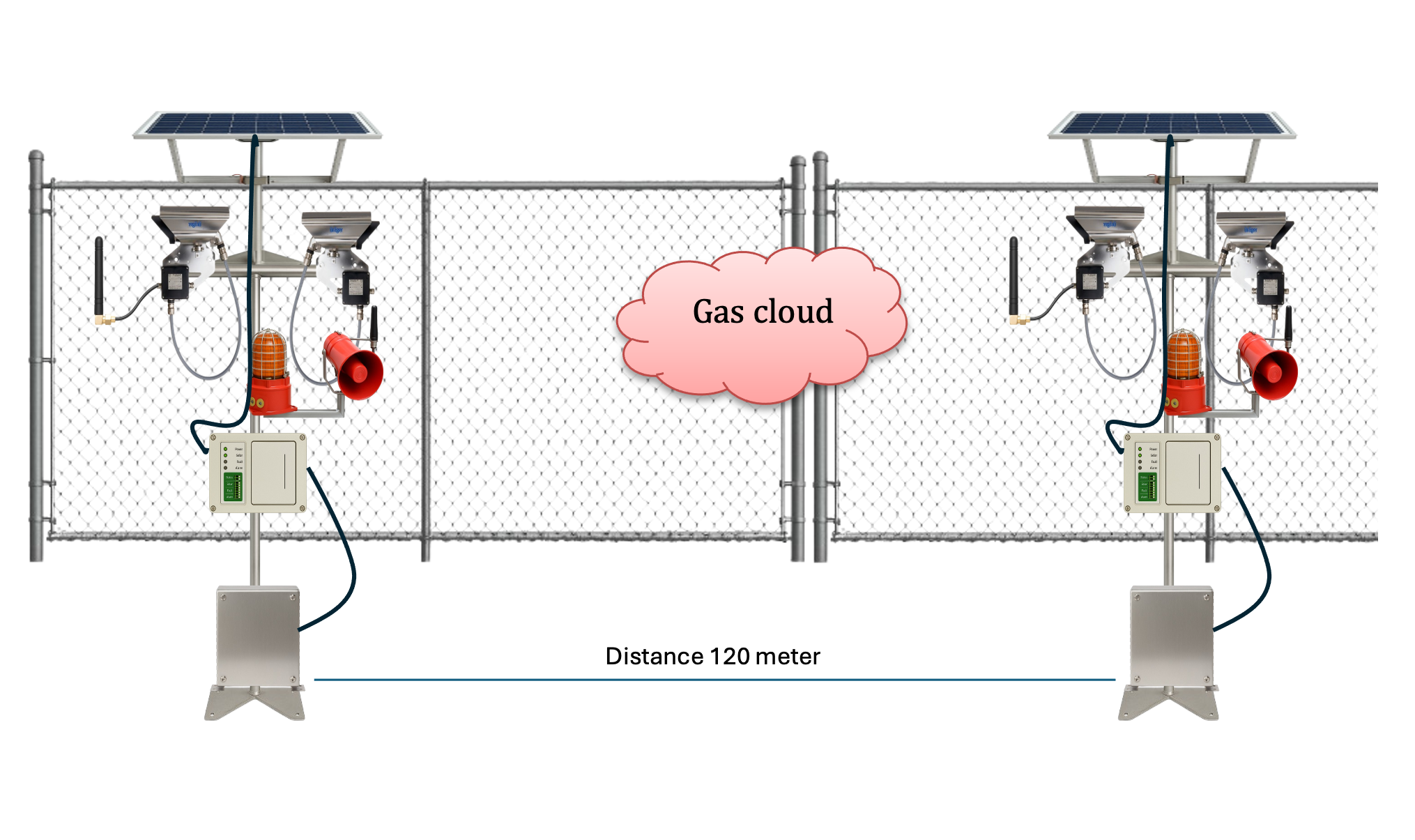
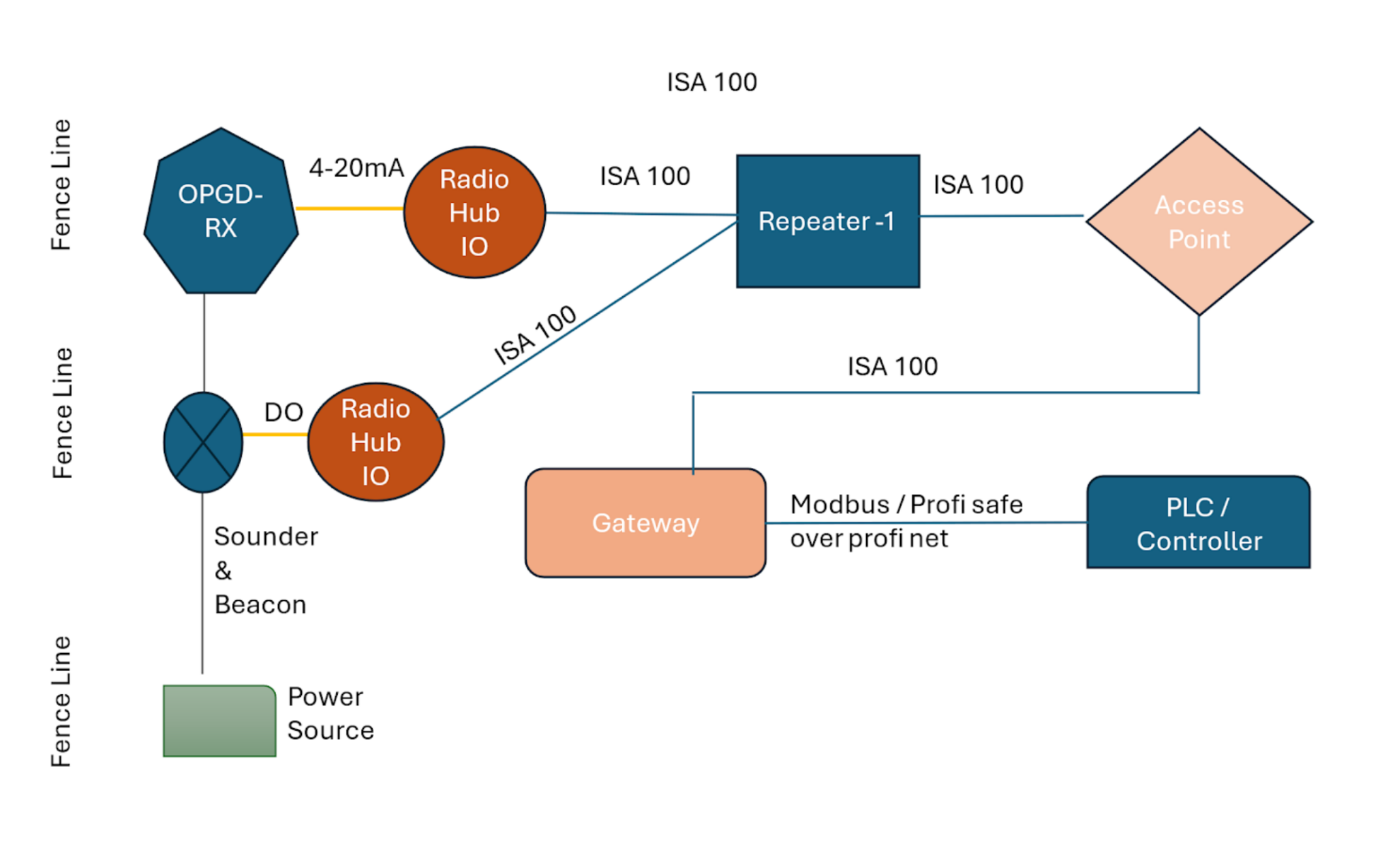
[Open Path Gas Detector] → [Repeater 1] → [Repeater 2] → [Repeater 3] → [ISA100 Gateway] → [PLC/DCS] → [Wireless Beacon Alerts]
5. How the System Works – End-to-End Communication Flow
Gas Detection (Event Trigger):
Open Path Gas Detectors continuously scan the area for flammable gas. When gas concentration exceeds the predefined threshold, the detector generates an alarm signal.
Signal Transmission:
The alarm signal is transmitted to the RadioHub IO module, which converts it into a wireless ISA100.11a signal. Depending on the assigned network topology, the signal is then routed either directly to the gateway or through the nearest repeater.
Repeater Handoff and Signal Routing:
Each repeater receives and forwards the signal to the next repeater in the chain or directly to the gateway.
Gateway Communication:
The final repeater relays the signal to the ISA100 Wireless Gateway, which converts the signal to Modbus, Profisafe over Profinet.
Control Room Integration:
The gateway forwards the converted signal to the PLC or Controller to Monitoring room for real-time monitoring.
Alarm Activation:
Simultaneously, a wireless trigger is sent to Radio Beacons, providing instant visual alerting in the field.
Power Autonomy:
Every Transmitter node is powered by solar panels and battery packs, offering 72-hour autonomy and scalability.
6. Key Technologies Used
| Component | Details |
|---|---|
| Gas Detector | Open Path, wireless-capable, Zone 1 compliant with Radio Hub |
| Repeater | Dräger wireless repeater with mesh routing support |
| Gateway | ISA100, Modbus, Profisafe over Profinet |
| Visual Alarm (Beacon) | Wireless, Zone 1 compliant, remote activated |
| Power System | 240W solar panel + 24V Ex d battery system |
7. Benefits & Solutions Delivered
- Reduced Cabling: Full wireless data and power design
- Zone 2 Compliance: All devices certified for hazardous area usage
- Rapid Installation: Reduced project timelines by avoiding trenching/cabling
- Real-Time Monitoring: Direct control room interface for immediate safety alerts
- Scalable Architecture: Easily integrates additional wireless safety devices in future
- Cost-Effective Power: No reliance on utility power; solar-based for long-term savings
8. Price Comparison & Cost Efficiency
While detailed pricing is not provided, the following cost factors are implied:
- Estimated Savings: 40–60% in infrastructure and labor costs over a 1 km+ perimeter
9. Future Scalability
- Plug-and-play addition of flame detectors, MCPs, or additional beacons
- Mesh architecture expansion via repeater chains
- Battery and solar units supporting more devices without redesign
10. Conclusion
The proposed wireless open path gas detection solution is a strategic and cost-efficient upgrade for hazardous perimeter monitoring. By eliminating physical infrastructure and utilizing wireless ISA100 technology with solar autonomy, the solution offers high reliability, safety, and scalability for future expansion. It serves as a benchmark model for off-grid hazardous zone safety systems in similar oil & gas applications, delivering value across installation speed, operational efficiency, and safety assurance.